by Tim Leininger
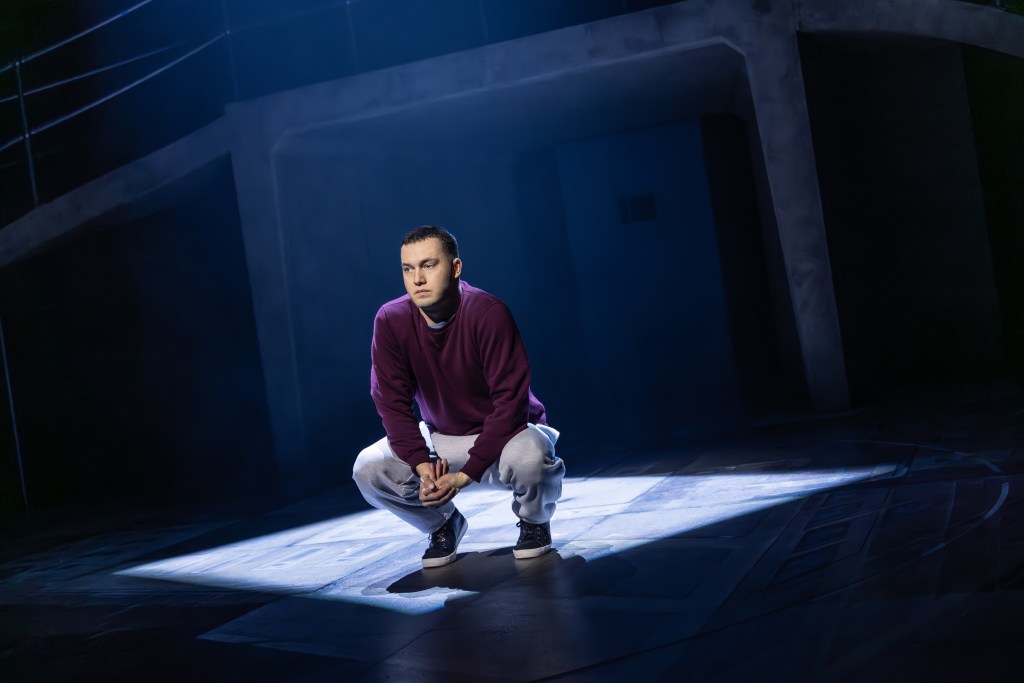
Will Harrison as Jacob in Manhattan Theatre Club’s production of Punch by James Graham, directed by Adam Penford. ©Matthew Murphy
Violence can have unalterable consequences but hope and reconciliation can offer a chance at redemption. Such is the truth behind James Graham’s new play, Punch, based on Jacob Dunne’s book Right from Wrong, directed by Adam Penford, running through Nov. 2 at Manhattan Theatre Club’s Samuel J. Friedman Theatre at 261 W. 47th St. in New York City.
Based on the true story of Jacob Dunne, here played by Will Harrison, a young man from Nottingham, England, who spends the bulk of his time acting out with the local hoodlums. When word get out that there is an altercation happening at a local watering hole, he shows up and one-punches James Hodgkinson, who is killed as a direct result of the assault. If you’re unfamiliar with the vernacular, a “one-punch” is like a sucker punch where a person is defenselessly hit resulting in severe injury or death.
The play focuses primarily on the fallout of the attack. Harrison dynamically displays Jacob juggling a mixed bag of emotions from remorse for his action to a desire for revenge against the friend of his that ratted him out as the one who struck James. Meanwhile, James’ parents, Joan (Victoria Clark) and David (Sam Robards), are attempting to understand what happened through a mediator, Nicola (Camila Canó-Flaviá), who can broker a meeting between them and Jacob once he is out of prison.
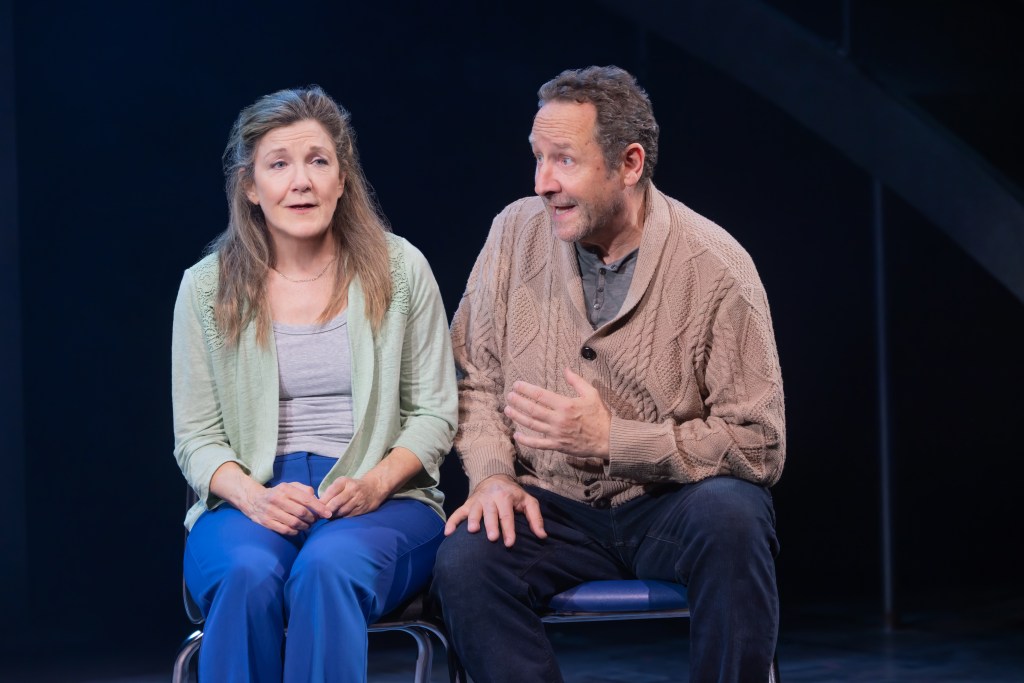
Victoria Clark and Sam Robards in Manhattan Theatre Club’s production of Punch, written by James Graham, directed by Adam Penford. ©Matthew Murphy
Punch is quite moving at times, the daring of a story about a man who committed manslaughter, the parents of the deceased trying to bridge the chasm between them, has the potential for many pitfalls into saccharine tropes of melodrama that would threaten the sincerity of the story. But Graham and Penford avoid such trite narrative intentions. Instead, distrust and fear permeate the characters as they question each other and themselves as to whether or not they should go forward with their actions. Victoria Clark, back on the Broadway stage after her stellar performance in Kimberly Akimbo, gives one of the best beats in the play as she reads a letter that Jacob has sent to her regarding the welfare of his own mother. It’s unspoken and invested with sensitivity and heart. Sam Robards’ David is a bit more reserved and reticent in potentially reconciling with the man who killed his son. Though David is a bit more restrained, Robards does allow the emotion behind the character to project in a way that the audience can tell that he is suffering just as much as Joan.
The second act of Punch is far better constructed than the first act. Graham, who wrote the compelling Ink, which ran on Broadway in 2017, chose to tell much of the first act through monologues by Jacob, which dampens much of the drama as we are frequently told what has happened versus showing us what happened. It’s a narrative cheat and undercuts the drama. Its act one framing has Jacob at a group meeting, presumably for convicts attempting to reintegrate into society, or people with anger management issues. Jacob’s focus quickly turns to talking to the audience versus the group — it is easier — as he tells us of his life, the events leading up to the killing, and the aftermath. These monologues are broken up by quick scenes that help give deeper context to what he’s talking about. It would have made more sense to have the scenes played out in their fullness. The monologuing takes away from the drama versus showing us what he is talking about. The second act pivots from that and we get far less soliloquizing on Jacob’s part. It flows much more smoothly and engaged me more with the story.
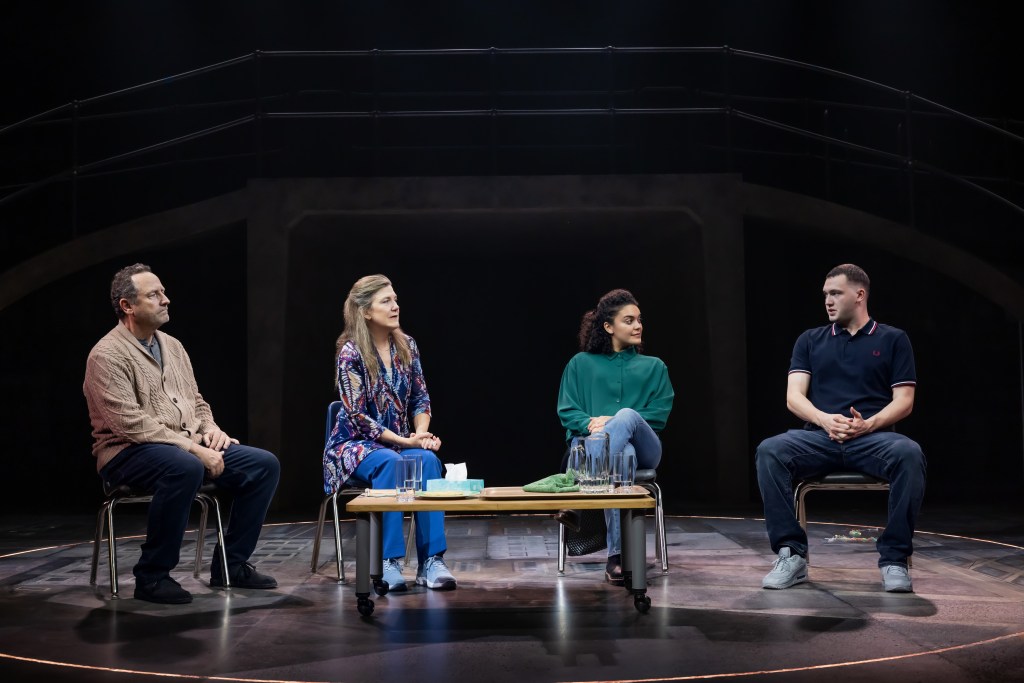
Sam Robards, Victoria Clark, Camilla Canó-Flaviá and Will Harrison in Manhattan Theatre Club’s production of Punch, written by James Graham, directed by Adam Penford. ©Matthew Murphy
Anna Fleischle’s scenic design is stark and dreary. It evokes a somberness through metallic grays and blacks. The degree of hope in the show’s palate comes from the costume design, particularly with the wardrobe for Joan, who has a bit more variety of color than everyone else, who are all dressed in monotone colors, reenforced by some excellent stark lighting by Robbie Butler. It subtly notes Joan being the center of hope for reconciliation, and the emotional ally for the audience through the play.
Punch, even with its dramatic premise and opening, tends to drag through much of the first act, mostly due to how the narrative is presented around Jacob’s monologuing. But, when the play deviates from this in the second act and the characters are presented with more interaction, the play picks up, and we are presented with an inspirational, emotionally charged drama with heart and compassion. With a world that is increasingly brutal in its vilification of the other, Punch offers hope in the possibility of forgiveness, repentance, and reconciliation.
PUNCH
TICKETS: https://www.manhattantheatreclub.com/
PRODUCTION
Written by James Graham
Based on the book Right from Wrong by Jacob Dunne
Directed by Adam Penford
Scenic & Costume Design: Anna Fleischle
Lighting Design: Robbie Butler
Original Music & Sound Design: Alexandra Faye Braithwaite
Movement Director: Leanne Pinder
Dialect Coaches: Charlotte Fleck, Ben Furey
Casting: Caparelliotis Casting & Kelly Gillespie
Production Stage Manager: Richard A. Hodge
CAST (in alphabetical order)
Camila Canó-Flaviá as Clare/Nicola
Victoria Clark as Joan/Nan
Will Harrison as Jacob
Cody Kostro as Raf/Sam
Piter Marek as Tony/Derek/DS Villers
Sam Robards as David/Raf’s Dad
Lucy Taylor as Mum/Wendy
Ensemble: Kim Fischer, Jacob Orr, Amber Reauchean Williams
 Yesterday's Matinee
Leave a comment