by Tim Leininger
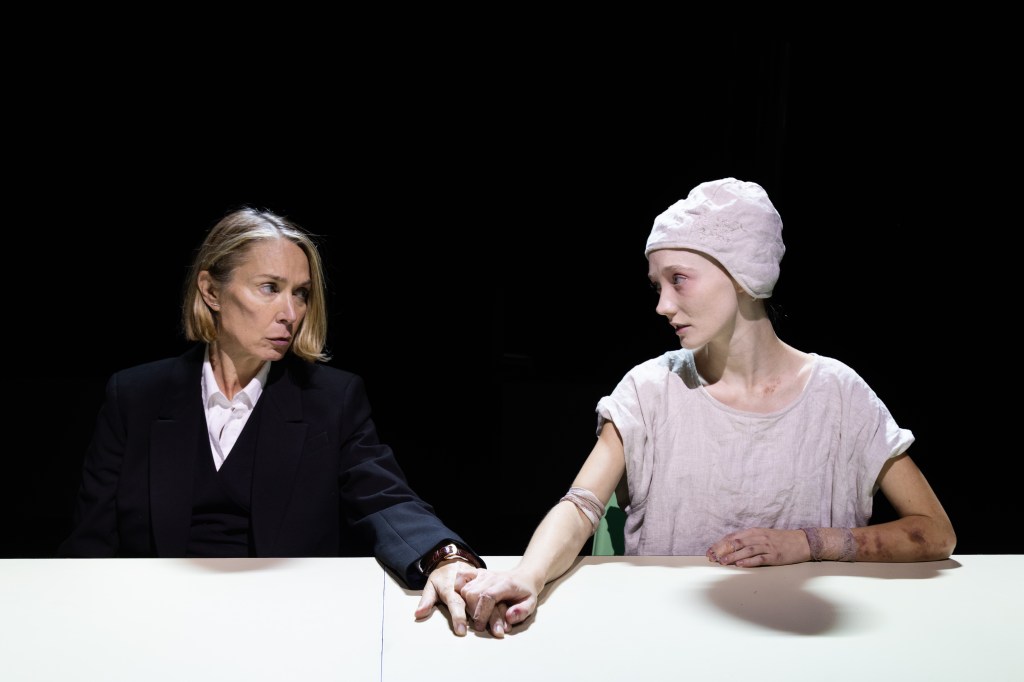
(l to r) Elizabeth Marvel and Elizabeth Yeoman in a scene fromAnd Then We WereNo More. (Photo by Bronwen Sharp)
In his 1949 review of George Orwell’s novel 1984 in the New Statesman, V. S. Prichett wrote, “I do not think I have ever read a novel more frightening and depressing; and yet, such are the originality, the suspense, the speed of writing and withering indignation that it is impossible to put down.” 76 years later, the echoes of Prichett’s apt observation of Orwell’s dystopian drama ring with new resonance with Tim Blake Nelson’s new play And Then We Were No More, directed by Mark Wing-Davey, running through Nov. 2 at the Ellen Stewart Theatre at La Mama at 66 E. 4th St. in New York City.
Set in the not-too-distant future, And Then We Were No More draws inspiration from not only Orwell, but Franz Kafka’s “In the Penal Colony” and Aldous Huxley’s Brave New World. As I just literally finished rereading 1984 a week ago and is fresh in my brain, my connections are going to be closest to that than anything else.
We are taken into the belly of a prison. Upon entering the theater, all we see are reflective panes of glass, having us literally reflect upon ourselves until the show beings. An inmate, literally credited as The Inmate (Elizabeth Yeoman) — all roles are assigned credit for their identity in their world, not their names — is set for execution. A Lawyer (Elizabeth Marvel) is assigned to represent The Inmate who has requested a change of execution. The Lawyer, who holds some sense of responsibility — and reluctancy for that matter — is good at her job and we discover along with her a history of abuses conducted by the government upon The Inmate while she was detained at another prison before being transferred. This leads to a show trial with her defending her client while An Official (Scott Shepherd) represents the State.

(l to r) Elizabeth Yeoman and Elizabeth Marvel in a scene fromAnd Then We WereNo More. (Photo by Bronwen Sharp)
Tim Blake Nelson’s version of this world feels like an early concept of what would eventually become George Orwell’s Oceania before Big Brother had full control. The system hasn’t become the blend of Nazi and Soviet styles of fascism. It is still evolving, learning from their mistakes and correcting them as they execute people through a purportedly painless process. David Meyer’s scenic design and Marina Dragnici’s costume design is definitely leading us in that direction with its stale color palate, the most eye grabbing element, the giant orange tubes that run to the center of the device that kills the prisoners of the State up center stage, ominously lit by Reza Behjat.
Famously, Orwell considered 1984 a satire. But, with the current political landscape that dominates our current world, it is difficult to view And Then We Were No More as one. The unbelievable sometimes feels all too possible now. Yet, with the proverbial mirror literally being held up to the audience, there is a dark streak of satirizing the criminal justice system by taking it to the extreme as it is represented here. Is The Inmate guilty of the crimes she committed? Based on the evidence provided by the play, yes. But, after the barbaric treatment she received, does the death penalty still hold viability? Tim Blake Nelson spends the bulk of the play arguing this issue, putting on full display the sadistic and sociopathic qualities of the people who run this facility, while the Lawyer desperately dissects the process of the prison system, designed to vaporize people out of existence and memory who are undesirable to the State.
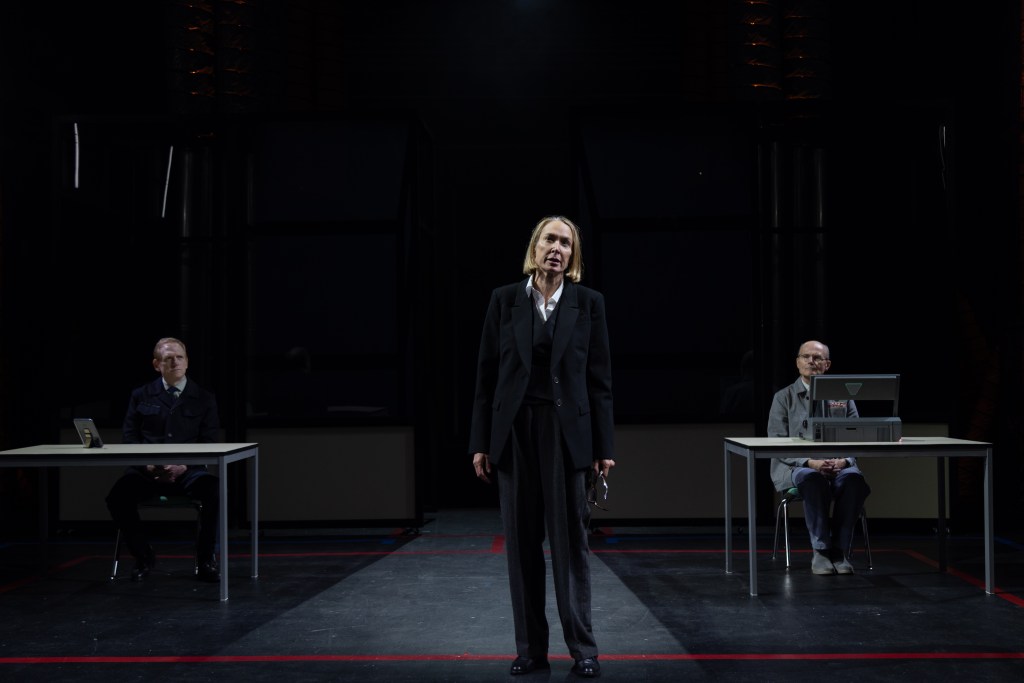
(l to r) Scott Shepherd, Elizabeth Marvel, and Henry Stram in a scene fromAnd ThenWe Were No More. (Photo by Bronwen Sharp)
The theme of the privatization of the prison system and the desire to create a more efficient means of execution is represented through the character of the Analyst, played by Jennifer Mogbock, whose sociopathic attitude layers over the more emotionally argumentative Official. She is only eclipsed by the more psychopathic Machinist (Henry Stram) who has a terrifying glee about him and his love for the execution device, which we do get to see in use at one point, and frankly, it is a horrifying experience, one in which audience members prone to queasiness may need to look away.
The emotional heart of the play rests in the performances of the two Elizabeths. Marvel’s Lawyer is irrevocably altered from her experience, not only with The Inmate, but in witnessing the criminal justice system as it stands in the play. Her performance starts tempered, then her evolution to becoming awakened to the reality around her is a performance of passion and desperation. Elizabeth Yeoman, meanwhile, gives a heartbreaking performance of a murderer who has been abused so extensively by the prison system that her higher brain function has been irreversibly altered to the near point of incomprehension.
Scott Shepherd should also be commended for his ability to give the Official ability to speak doubletalk with exceptional ease as he argues for the State against the Lawyer. His arguments would almost be believable if it wasn’t for the absolute absurdity of it.

(l to r) Scott Shepherd, Elizabeth Marvel, and Jennifer Mogbock in a scene fromAndThen We Were No More. (Photo by Bronwen Sharp)
And Then We Were No More is like an unofficial prequel to 1984 and Tim Blake Nelson owes a big debt to his predecessors, Kafka, Huxley and Orwell, for what this play offers in theme and tone. If anything, it dances on the line of imitation. Extending my 1984 comparison, it inverts the point of view from seeing the world from Winston’s eyes to seeing it from the Ministry of Love’s perspective. I kind of wish he took the bait and leaned into that comparison and say it was an actual prequel. It would pay the debt of appreciation a bit more squarely. That doesn’t stop And Then We Were No More from being a bad play, far from it. It clearly represents its theme of individuality in a society where the government is trying to codify a singular national mind through fear, with additional themes of abuses of the prison system and the morality of capitol punishment. It’s a bit harrowing at times, but there’s nothing wrong with that. The cast is great, spotlighted by three challenging, dynamic performances by Marvel, Shepherd, and Yeoman. It’s a brutal watch, but the more we hold the mirror up to us, as Tim Blake Nelson does here, the more we can hopefully fix what’s wrong within.
AND THEN WE WERE NO MORE
TICKETS: https://www.lamama.org/
PRODUCTION
Written by Tim Blake Nelson
Directed by Mark Wing-Davey
Scenic Design: David Meyer
Costume Design: Marina Draghici
Lighting Design: Reza Behjat
Composer & Sound Design: Henry Nelson & Will Curry
Properties Design: Patricia Marjorie
Fight Director: Mark Olsen
Production Stage Manager: Leo Nobiletti
Graphic Design: Pioneer Works
Production Manager: Erica Zippel Schnitzer
Technical Director: Pedro Lima, Five Ohm Productions
Casting: Calleri/Jensen/Davis
Press Representative: Keith Sherman & Associates
CAST (in order of appearance)
Scott Shepherd as An Official
Elizabeth Marvel as A Lawyer
Jennifer Mogbock as An Analyst
Elizabeth Yeoman as The Inmate
Henry Stram as The Machinist
Guards: William Appiah and Kasey Connolly
Engineers: EJ An and Craig Wesley Divino
 Yesterday's Matinee
Leave a comment