by Tim Leininger
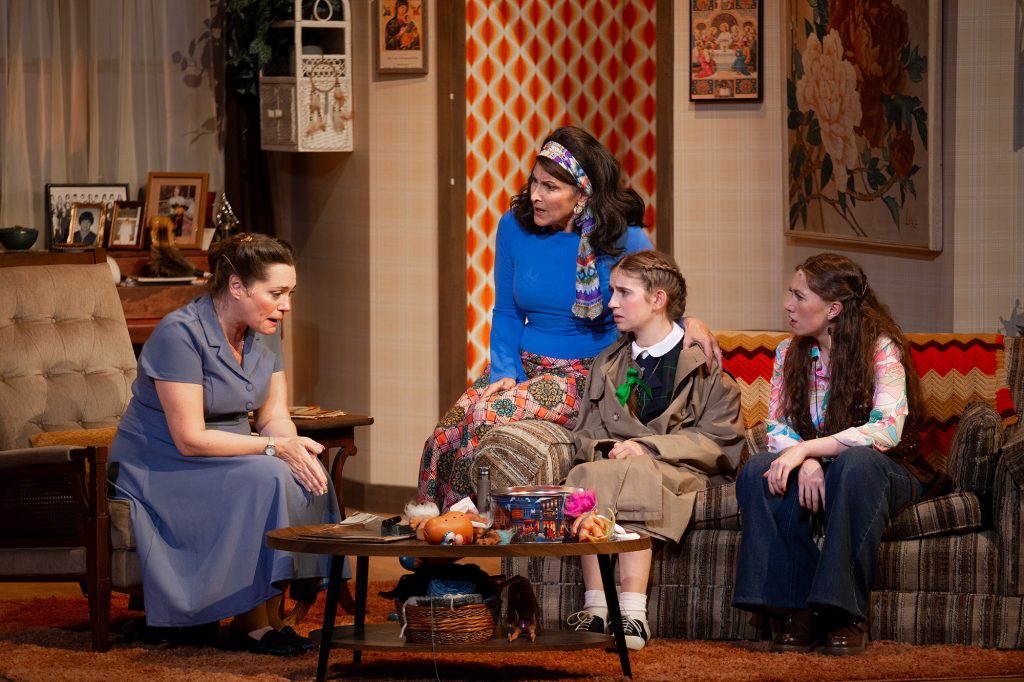
Photo courtesy of Ivoryton Playhouse
Families are replete with potential drama and in the right hands, that drama can become particularly funny. Such is the case with Ivoryton Playhouse’s production of Incident at Our Lady of Our Perpetual Help, written by Katie Forgette, directed by Jacqueline Hubbard, running through Oct. 26 at the playhouse at 103 Main St. in Ivoryton, Connecticut.
The family in question are the O’Sheas, a family in 1973 Boston where the father, Mike O’Shea (Rod Brogan), is a blue collar worker; the wife, Josephine “Jo” (Amber Quick), keeps the house, helps out with volunteer work with the local Catholic church, does work as a typist for a neighbor author, and tends to her two daughters, Becky (Maggie Hamel) and Linda (Autumn Eliza Sheffy). Also, along for the ride is Becky’s hard drinking sister, Terri Carmichael (Rebecka Jones), who is separated from her husband and does her best to offer some sage advice to her nieces. Unseen but also in the house is Grandma O’Shea, who claims to be bedridden, but the family has their doubts, who frequently calls for assistance for someone in the family to tend to whatever need she has in the moment.
The story is told as a memory play by Linda, who recounts a few days from her youth, where she is planning to go off to college and be with her boyfriend, but a series of events threatens her future as well as her family’s reputation. It all starts off quite innocuous, at least from our modern eye. Jo, who is so uncomfortable with the idea of having “the talk” with Becky, bestows the responsibility on Linda, who, none too pleased with the idea, tells her little sister rather bluntly about what happens to the female body during puberty and what sex is. Becky happens to enjoy roleplaying as a sleuth, inspired by all the film noir she watches with Terri, and secretly records the conversation with Linda. When the tape is accidentally played in school in front of Father Lovett (Rod Brogan), the family must find a way to save their reputation before Father Lovett exposes the family for Linda’s less than clinical health lesson.

Photo courtesy of Ivoryton Playhouse
From our generally more progressive 2025 view, these issues seem benign, but in a conservative Catholic pocket of 1973 Boston where reputation is everything, the smallest indiscretion clashes with and can turn you into a pariah. Linda’s more liberal views and lifestyle and a predictable first act finale add to the drama.
Though yes, the act one finale is predictable, the play is delightfully silly and a full of laughs, especially in how the family dynamics are played out as each of the female O’Sheas’ personalities have just enough eccentricities to give the ladies color and texture without having any of them become annoying. They are well-thought-out characters and performed with intelligence and charisma. The cast is excellent and directed with polish by Hubbard.
The problem with the play is the memory play construct. The first act could be trimmed by about 10 minutes by cutting out Linda’s opening monologue to the audience introducing all the family members. We find out who the characters are organically immediately afterward, making it redundant. There is a conceit that the play is a memory play on Linda’s behalf, but the other characters interject themselves from time to time, another element of the play that is unnecessary. The characters are well-crafted, and it feels like playwright Forgette should have more faith in them to play the scenes out without the asides. Another thing this would resolve is that in act two, Linda, who is supposed to be the main character and narrator, isn’t in the story’s climax with Father Lovett, which undercuts the narrative premise. If Linda isn’t the narrator, it would allow the other characters more agency who are in that scene to play out what happens. The only part of the play where the narration does work to its fullest is in the conclusion. If all that was cut, the play would be a leaner 1 hour 45 minutes or even shorter.
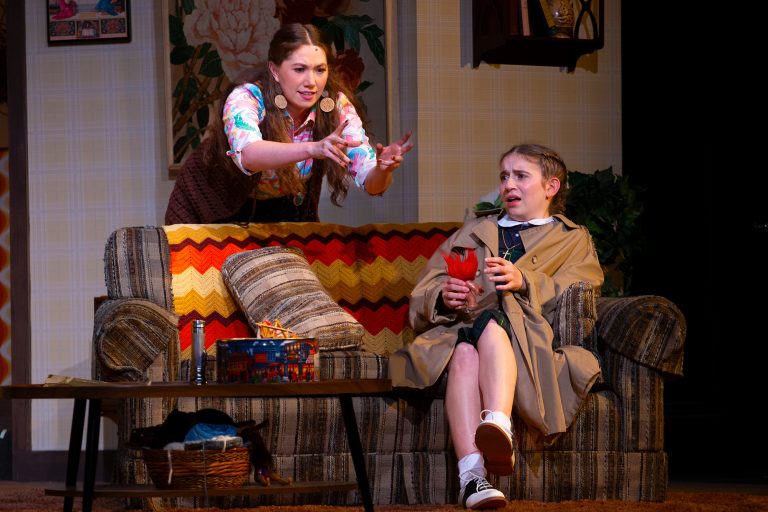
Photo courtesy of Ivoryton Playhouse
That climax is a great scene, regardless of Linda’s lack of involvement. Rebecka Jones and Rod Brogan, with Maggie Hamel capture the humor of the scenario while also maintaining a believability to the absurdity of the whole situation as Becky and Terri try to keep Father Lovett from gaining access to Mike, who is now also bedridden from an on-the-job injury (remember, Father Lovett and Mike are played by the same person).
Brogan plays a third role, the church busybody, Betty, and Brogan has a lot of fun pushing Betty into every situation and exhausting the rest of the characters.
I love Starlet Jacobs’ scenic design of the O’Shea home. There are some delightful details hidden throughout, especially on the kitchen/dinette side of the house where Terri hides her liquor bottles.
Incident at Our Lady of Perpetual Help is really a second wave feminist piece presented as a family farce. Women’s health, autonomy, freedom of speech, and other topical elements are replete, portrayed by fleshed out inspiring characters. If only there was more trust in the characters to tell this story they really want to tell already, and not lean so much on narration to do the job for them.
INCIDENT AT OUR LADY OF PERPETUAL HELP
TICKETS: https://www.ivorytonplayhouse.org/
PRODUCTION
Written by Katie Forgette
Directed by Jacqueline Hubbard
Stage Manager: James Joseph Clark
Scenic Designer: Starlet Jacobs
Sound Designer: Shyloh-Symone Bailey
Props Master: Kat Schorn
Assistant Stage Manager: Holly Price
Lighting Designer: Autum Casey
Costume and Wig Designer: Elizabeth Saylor
CAST
Rod Brogan as Mike O’Shea/Father Lovett/Betty
Maggie Hamel as Becky O’Shea
Rebecka Jones as Terri Carmichael
Amber Quick as Josephine “Jo” O’Shea
Autumn Eliza Sheffy as Linda O’Shea
 Yesterday's Matinee
Leave a comment