
by Tim Leininger
Photos by Julieta Cervantes
NEW YORK – A revival of a musical about “unmitigated ego” has been hanging around on Broadway for nearly 30 years, so I suppose it is time for a new one and composer/lyricist Stephen Schwartz (Wicked, Children of Eden) along with Lindsey Ferrentino — who has written the book — have written what may be the most controversial musical of the season with The Queen of Versailles, directed by Michael Arden and choreographed by Lauren Yalango-Grant and Christopher Cree Grant, running at the St. James Theatre at 246 W. 44th St. in New York City.
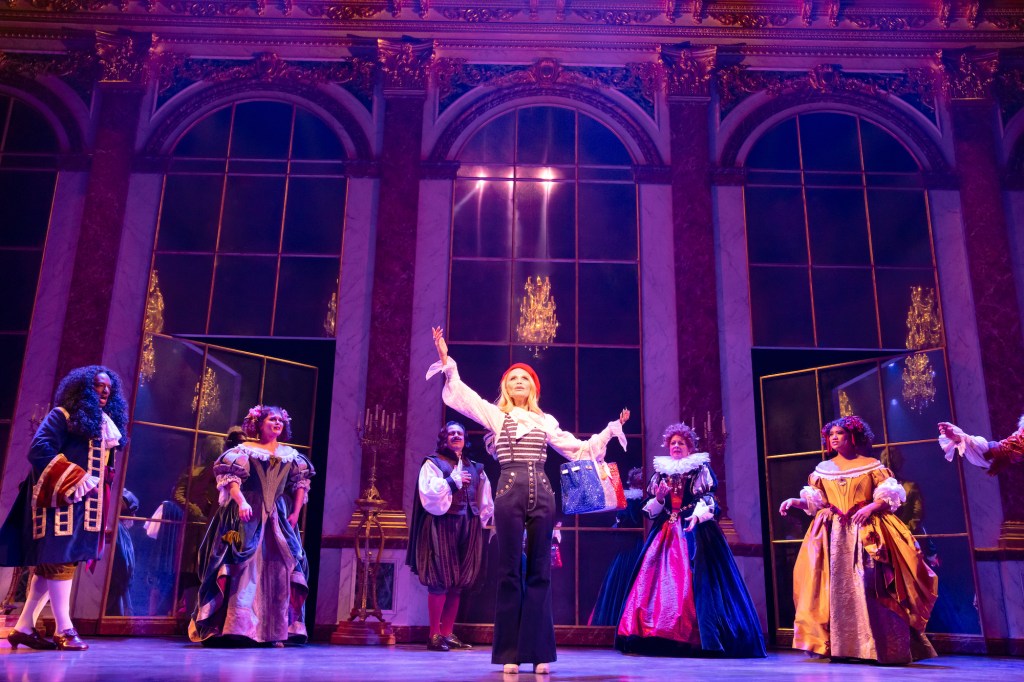
Based on Lauren Greenfield’s documentary of the same name and the life stories of Jackie and David Siegel, The Queen of Versailles is a morally complicated musical about Jackie and David, played by Kristin Chenoweth and F. Murray Abraham respectively. The first new musical of Schwartz to grace the Broadway stage since Wicked opened in 2003, as a composition and structured story, The Queen of Versailles is better than its predecessor — which isn’t saying much coming from me, as I consider Wicked to be the most overrated musical of the past 25 years, granted, my issues with Wicked have more to do with the book than the score. Schwartz has written a more emotionally complex score here with some songs like “Pretty Wins” and “Little Houses” laced with deep, cutting emotion. I love the neo-classical period operatic score for the 18th Century scenes featuring Louis XIV (Pablo David Laucerica) and Marie Antoinette (Cassondra James). It’s appropriately austere and has a certain pomposity about it. But the music for Jackie can be a bit all over the place. It’s at one moment a bit pop, another moment country, and then a bit more adult contemporary. It meanders a bit too much and lacks focus.
Photos by Julieta Cervantes
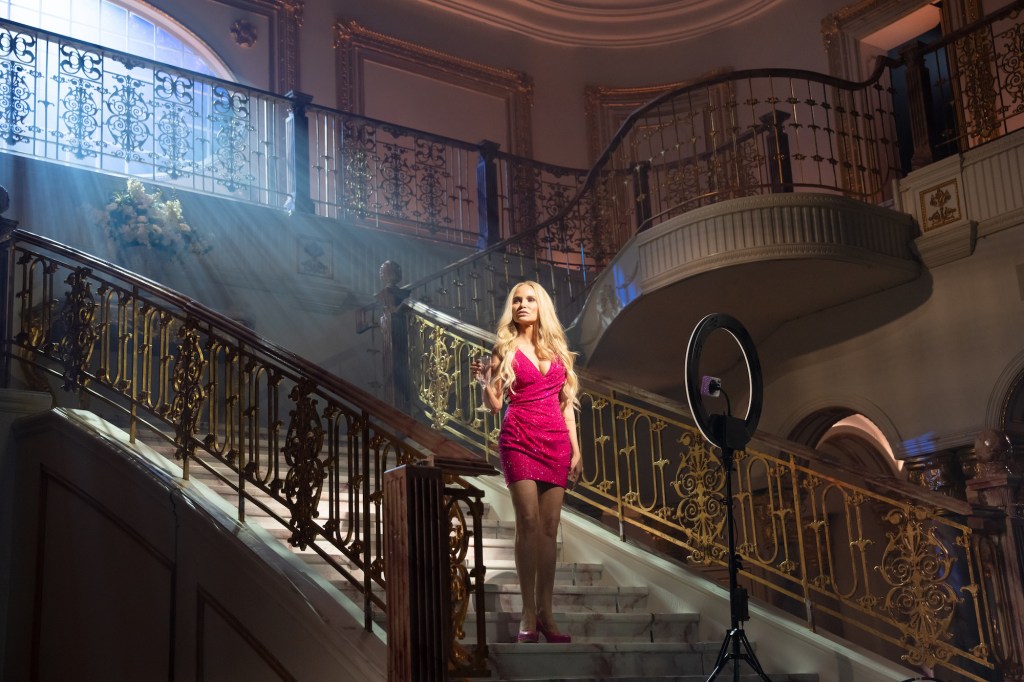
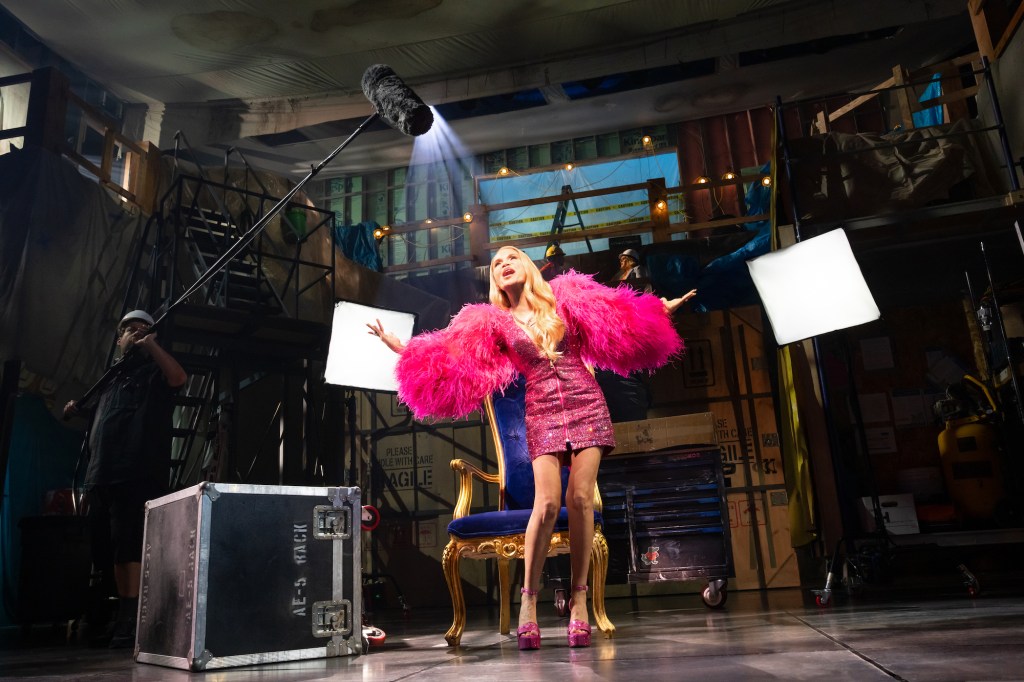
Chenoweth, who has herself grown and matured as an artist in the last 22 years, gets to introduce a character that can be viewed as Schwartz’ attempt at creating his own Norma Desmond or Mama Rose. I say “attempt” as time will only tell whether the character will have any kind of long-term legacy. The character is engrossing, yet also very disturbed in her selfish pursuit of wealth and recognition. When Chenoweth ascends the stairs in the musical’s finale “This Time Next Year,” there is a parallel descent into a certain kind of madness as her determination supersedes her compassion for everyone around her, and Chenoweth layers the performance with fortitude and authority laced with bitterness.
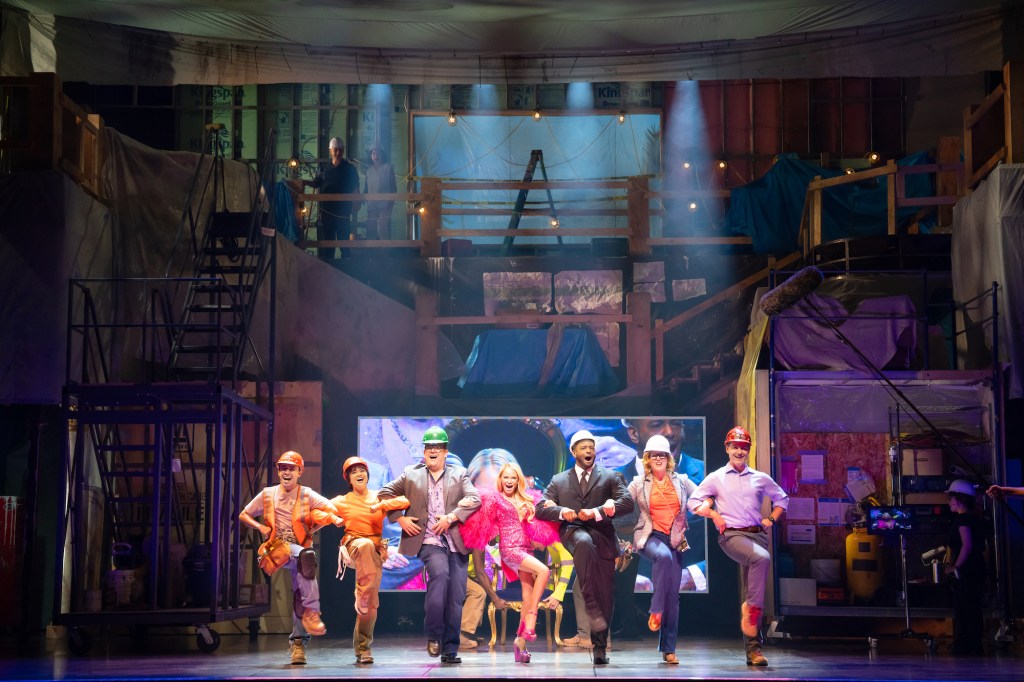
What’s going to determine the musical’s legacy is will a modern audience accept a musical about an ultra-wealthy billionaire whose narcissistic and megalomaniacal inclinations make her reprehensible. This is all part of the twisted irony that is this show, as the real Jackie Siegal, though not a producer, stands to make money off it if it pulls a profit. I wonder if she even cares that the show paints her in such an unflattering way as long as it makes her more money so she can eventually finish Versailles, her palatial palace that is the center of the musical Jackie’s ambitions, a project that she and her now late husband have been working on for decades. Dane Laffrey’s scenic design of the unfinished Versailles draws certain parallels to the classic dilapidated home of Norma Desmond in Sunset Boulevard, with Versailles being an inversion, where the house is struggling to be built versus it falling into ruin. It’s beautifully detailed as it slowly comes together over the course of the musical.
Photos by Julieta Cervantes
Jackie, who was born in a working-class home in New York state, ultimately becomes a part of the social elite and after having taken a trip to the actual Versailles in France, proclaims how she would love to have a palace just like it. David, who was called the “King of Time Shares,” made a fortune off gullible people who didn’t know what they were investing in, and taking advantage of favorable lending policies at the time to make billions, and decides he’s going to give her just what she wants, a replica of Versailles in Orlando, Florida. Things go well until the economic collapse of 2007, and they lose their investments, having to pay back the banks for their outstanding loans. The musical then focuses on how they get their riches back, focusing on Jackie’s obsessive nature even in the face of family tragedy, and Schwartz and Ferrentino pull no punches in depicting Jackie’s struggle against what could be described as her better nature for her desire to hold onto the recognition, power, and wealth that was given to her by David. The scene where she sets up a foundation in response to a tragedy that happens in her life heavily implies that the palace is more important than the good deeds the foundation is supposed to be doing.
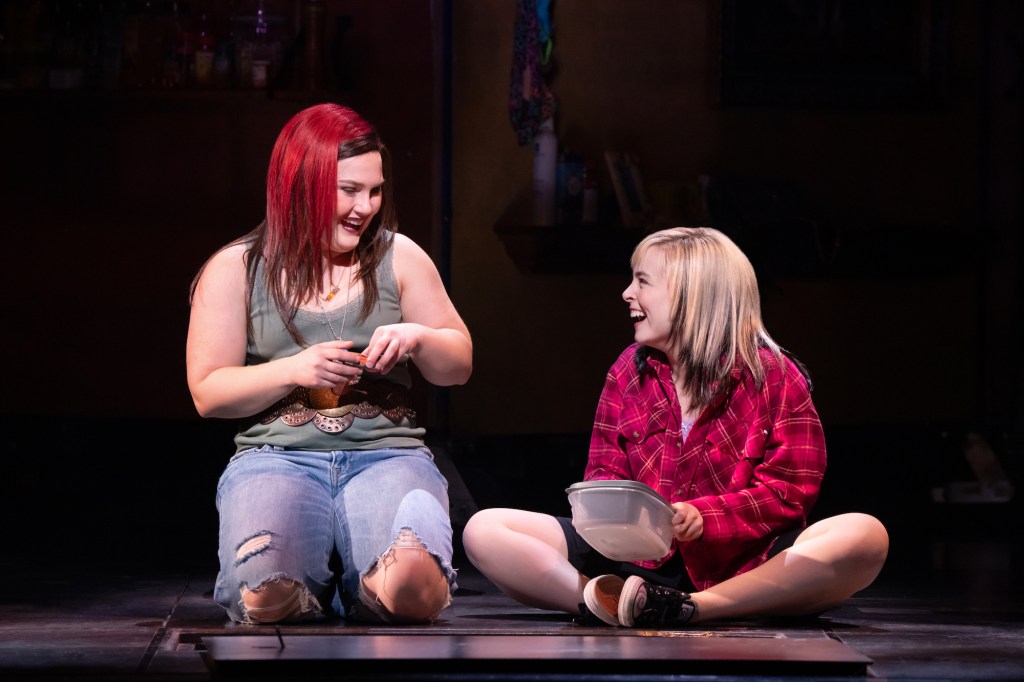
Jackie gets caught up in the glory of wealth and fame that it reaches the point of negligence toward her eldest child, Victoria (Nina White), who sees through the veneer of glitz and glamour. None of the Jackie’s other numerous children are featured in the musical, but there is a niece, Jonquil (Tatum Grace Hopkins) that features as Jackie’s replacement to Victoria, as Jonquil is initially taken by the ultra-wealth that she is experiencing for the first time. As much as Chenoweth is the star and has some amazing moments in the show, it’s White and Hopkins who bring a humanity to the story with Victoria’s critical eye and Jonquil’s enamored nature.
Photos by Julieta Cervantes
I am no fan of shows like The Housewives of… series. I don’t see any reason to voluntarily give people so desperate for attention any more recognition, time, fame, or fortune than they already have. Considering the political climate of our country, there’s an even greater bias against the upper class than usual — understandably so — and I see no reason to potentially give Jackie Siegal more money and recognition, even if the musical doesn’t present her in the best of light. Schwartz and Ferrentino do give her some explanation as to why she becomes who she is, as she is initially a hard worker, but the rampant patriarchy and base misogyny of the 1980s and 90s makes it difficult for her to get any real advancement, leading to a first marriage that goes bad. After winning the Mrs. Florida pageant, she meets David, who is significantly older than her, and the two get married. So, she doesn’t earn the billions of dollars that she ends up having. She marries into it. Those who are aware of how things went after the economic collapse of 2007 and the bail outs that came after it, you know that she wasn’t responsible for their return to status either.
The supporting cast is good. As I mentioned, White and Hopkins are excellent. F. Murray Abraham doesn’t actually sing much, but he’s ever present in the background, exuding David’s bitterness at losing his money; it consumes him and starts taking it out on Jackie. A key character in the musical that really reflects the genuine awfulness of the Siegel family is Sofia, beautifully played by Melody Butiu, the stalwart servant, who, working for billionaires, never makes enough money to have her own home or afford to travel to visit her family overseas. All the tragedies that Jackie experiences are overshadowed by Sofia’s tragedy of having to work directly for a billionaire who doesn’t give her a living wage and proper benefits.
Photos by Julieta Cervantes
The Queen of Versailles is one of Schwartz’ best works, but even with the blatant calling out of the horrid corruption of wealth, and dynamic performances all around, I know it will only stroke the ego of someone who is, as far as the musical is concerned, a pretty awful human being. Why write a musical about this at all? Is it a warning, or a promotion? As Siegel stands to profit from it, it’s unfortunately both, which makes it a very difficult moral decision for anyone considering going. Personally, if I shelled out $55 or more for tickets, I’d feel pretty scummy about it.
THE QUEEN OF VERSAILLES
TICKETS: https://queenofversaillesmusical.com/
PRODUCTION: Music & Lyrics by Stephen Schwartz; Book by Lindsey Ferrentino; Based on Lauren Greenfield’s documentary film The Queen of Versailles and the life stories of Jackie and David Siegel; Directed by Michael Arden; Choreography by Lauren Yalango-Grant & Christopher Cree Grant; Music Supervision by Mary-Mitchell Campbell; Scenic & Video Design: Dane Laffrey; Costume Design: Christian Cowan; Lighting Design: Natasha Katz; Sound Design: Peter Hylenski; Hair & Wig Design: Cookie Jordan; Technical Costume Design: Ryan Park; Production Management: Juniper Street Productions; Props: Ray Wetmore, JR Goodman; Orchestrations: John Clancy; Music Coordinator: Kristy Norter; Advertising: RPM; Marketing/Strategy: On the Rialto; Public Relations: DKC/O&M; Ticketing & Revenue Director: Ben Simpson, ATG Entertainment; Social Media: Marathon Digital; Resident Director: Stephen Sposito; Production Stage Manager: Clarissa Marie Ligon; Casting: Stephen Kopel, CSA, Carrie Gardner, CSA, C12 Casting; Company Manager: James Viggiano; General Management: Baseline Theatrical, Beth Renoni & Andy Jones
CAST
Kristin Chenoweth as Jackie
F. Murray Abraham as David
Nina White as Victoria
Tatum Grace Hopkins as Jonquil
Greg Hildreth as Gary
Melody Butiu as Sofia
Stephen DeRosa as John & Others
Isabel Keating as Debbie & Others
Pablo David Laucerica as Louis XIV & Others
David Aron Damane as Ray & Others
KJ Hippensteel as IBM Manager & Others
Drew Elhamalawy as Plastic Surgeon & Others
Michael McCorry Rose as Ron & Others
Andrew Kober as Pageant Host and Others
Ryan Nixon as Sheri & Others
Shea Rennie as Sue & Others
Cassondra James as Marie Antoinette & Others
Yeman Brown as Worker & Others
Adam as Midas
 Yesterday's Matinee
Leave a comment