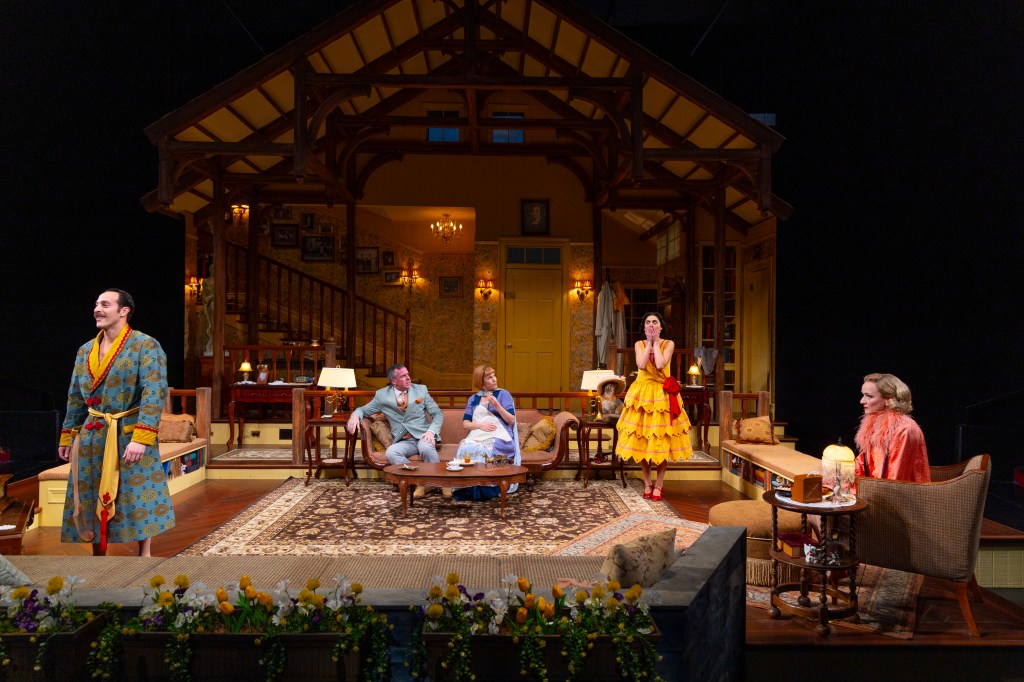
(Jordan Sobel, Craig Wesley Divino, Kate MacCluggage, Jetta Juriansz, and Mary Cavett in The Cottage (2026). Photo by T. Charles Erickson.)
by Tim Leininger
HARTFORD — Appreciation for a work of art can grow over time. For that purpose, I think repeat viewings or listening of certain pieces can help develop one’s view on a particular painting, song, play or movie. It can make your opinion solidify. Like, for me, even though it’s an award-winning play with raves from many of my colleagues, I absolutely hate Lucas Hnath’s A Doll’s House Part II, and repeat viewings of it only make me dislike it more. On the other hand, a repeat viewing can help appreciate it more for what it is.
When I first saw Sandy Rustin’s sex farce The Cottage when it opened on Broadway in July of 2023, my review was mixed at best. But now, with Hartford Stage’s production, directed by Zoë Golub-Sass, running through Feb. 8 at its theater at 50 Church St., my attitude toward the play has softened, enjoying it far more this go-around than two and a half years ago.
Set in an English countryside cottage in 1923, Beau (Jordan Sobel) and Sylvia (Mary Cavett) are having their seventh annual one-day affair when Sylvia announces to Beau that she has telegrammed both her husband Clarke (Craig Wesley Divino) and Beau’s wife Marjorie (Kate MacCluggage) that she is divorcing Clarke for Beau. In a normal world, this would seem like a simple problem, but in these kinds of comedies, nothing is easy as complications pile on one after another. Clarke happens to be Beau’s brother, Marjorie is pregnant, and Beau is anticipating Syliva to leave at her regularly scheduled time so he can have another tryst with Dierdre (Jetta Juriansz), who is to arrive at the cottage the morning Sylvia is supposed to leave.
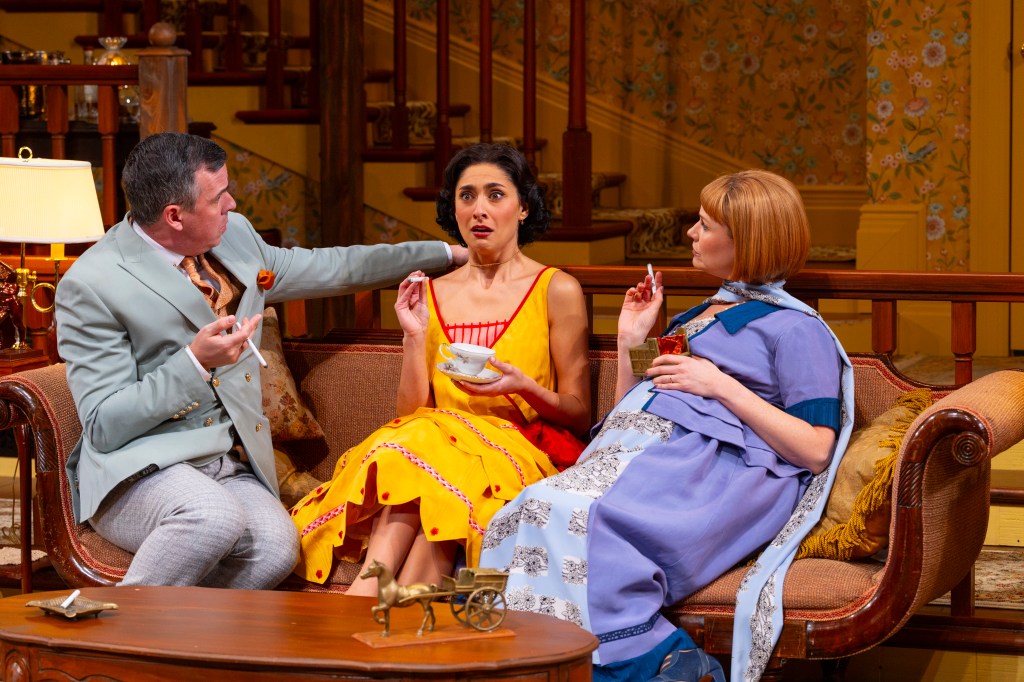
(Craig Wesley Divino, Jetta Juriansz, and Kate MacCluggage in The Cottage (2026). Photo by T. Charles Erickson.)
I think the key point of difference — for me anyway, as colleagues of mine are voicing other reasons for their change of heart to the play as well — is that director Golub-Sass has done a far better job with the cast in keeping an air of incredulity as the play progresses. Gone is much of the English propriety that dictates that regardless of how absurd the situation becomes; they will not betray their British stiff upper lip about their situation. Here, the characters feel the weight of their troubles and express it in their acting. This continues the flow of tension, even though most of everything that is to be revealed is done so before intermission. This time I looked forward to the arrival of Dierdre’s husband Richard (Matthew J. Harris) and the added tension he brings as she tells the rest of the party that he is likely going to come and kill Beau for having an affair with her.
Much of the Broadway production’s humor was dependent upon sight gags and slapstick antics, and though Hartford Stage’s production still has this, it isn’t dependent upon it. There is a lot more trust in the actors to carry the weight of the drama. The slapstick moments are still there, like Clarke coming out bedecked in an armor of pillows and the world’s longest single fart joke. So are the many hiding places for cigarettes, which you’re likely to miss all of them because there is so much action happening on stage. But the character moments are elevated enough that I actually cared for them this time. This is especially true of Sylvia, and Cavett does an excellent job of making her situation feel the most tenuous, as it is the 1920s, and it looks like the men will be protected by their gender and Dierdre and Marjorie have men they can depend upon to take care of them.
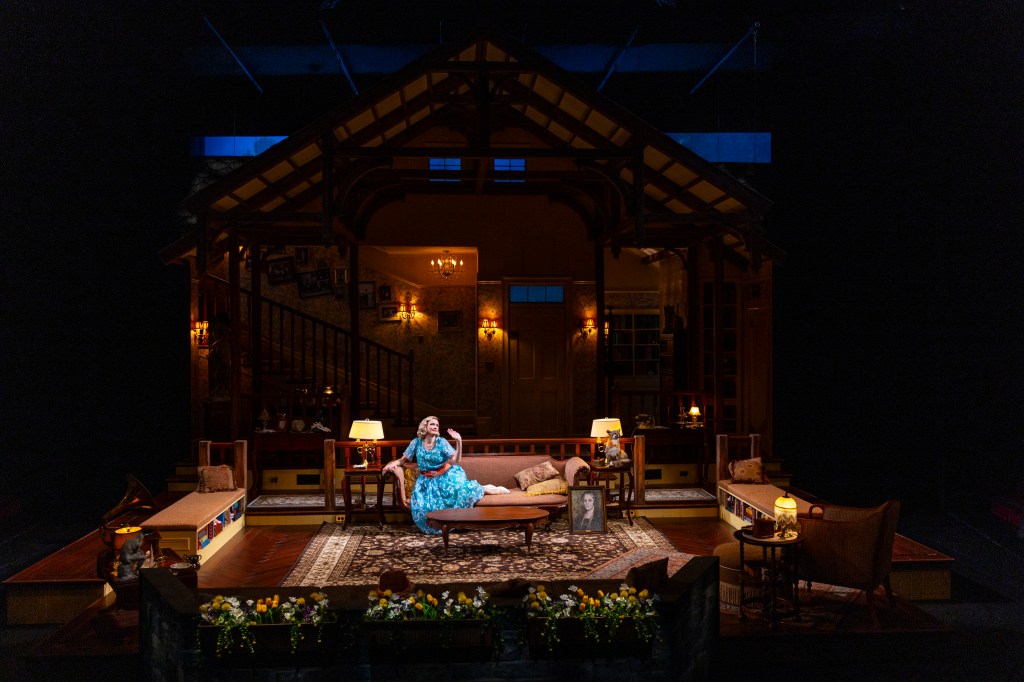
(Mary Cavett in The Cottage (2026). Photo by T. Charles Erickson.)
Sylvia’s situation and Cavett’s performance reenforces Rustin’s feminist theme throughout as Syliva develops from a dependent lover into an independent individual. Is she any more innocent than the other characters in the play? Maybe a little. If we’re measuring sins between the six, she is the one with the least to atone for, even if she is having an affair with her brother-in-law one day a year. Cavett elevates Sylvia’s character to the point of learning the most of who she is, allowing us to empathize with her more than the others.
The rest of the cast is hilarious. Sobel, Wesley Divino, and MacCluggage make a great slapstick trio as Beau and Clarke bumble about with their attempts to one up each other in various ways and Marjorie plays ringmaster with them both. Juriansz’ Dierdre is appropriately naïve yet laced with a youthful sexual exuberance, and Harris’ Richard is perfectly subversive — which is all I’ll say about him, because his reveal is a bit of a twist.
Tim Mackabee and Golub-Sass have made some significant changes in the scenic design, but it works. They invert the location of the window nook so that it’s downstage, which works for Hartford Stage’s thrust stage design. There is also a lot of attention given to the details of the set as everything has a purpose, beyond just aesthetic. As the play gets more frenetic, keep an eye on the set as the cast interacts with it. There are a lot of little beats to catch throughout. Hunter Kaczorowski’s costumes are also great with a delightful brilliance about them.
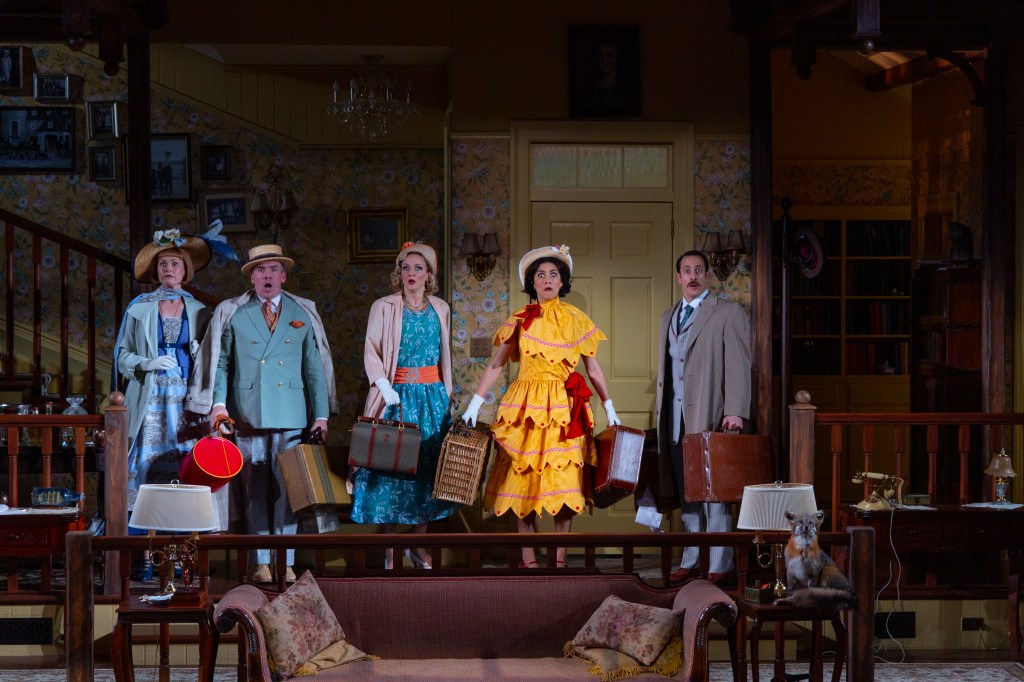
(Kate MacCluggage, Craig Wesley Divino, Mary Cavett, Jetta Juriansz, and Jordan Sobel in The Cottage (2026). Photo by T. Charles Erickson.)
Hartford Stage’s production of The Cottage is a significant improvement on a play that I initially felt was mediocre at best. Under the capable direction of Zoë Golub-Sass, the play has more depth of character and tension while not sacrificing its humor with the support of an excellent ensemble cast. I may have warded people off from seeing The Cottage two and a half years ago, but I do hope everyone comes and sees it now.
THE COTTAGE
PRODUCTION
Written by Sandy Rustin; Directed by Zoë Golub-Sass; Scenic Design: Tim Mackabee; Costume Design: Hunter Kaczorowski; Lighting Design: Evan C. Anderson; Sound Design: Nathan A. Roberts and Charles Coes; Wig & Hair Design: Tommy Kurzman; Fight Coordinator: Michael Rossmy; Dialect & Voice Coach: Julie Foh; Casting: Alldaffer & Donadio Casting; Production Stage Manager: Avery Trunko; Assistant Stage Manager: Alison Fischer Greene; Associate Artistic Director: Zoë Golub-Sass; Director of Production Bryan T. Holcombe; General Manager: Emily Van Scoy
CAST
Mary Cavett as Sylvia
Craig Wesley Divino as Clarke
Matthew J. Harris as Richard
Jetta Juriansz as Dierdre
Kate MacCluggage as Marjorie
Jordan Sobel as Beau
 Yesterday's Matinee
Leave a comment