(Production photo courtesy of Hartford Stage. Credit: T. Charles Erickson)
by Tim Leininger
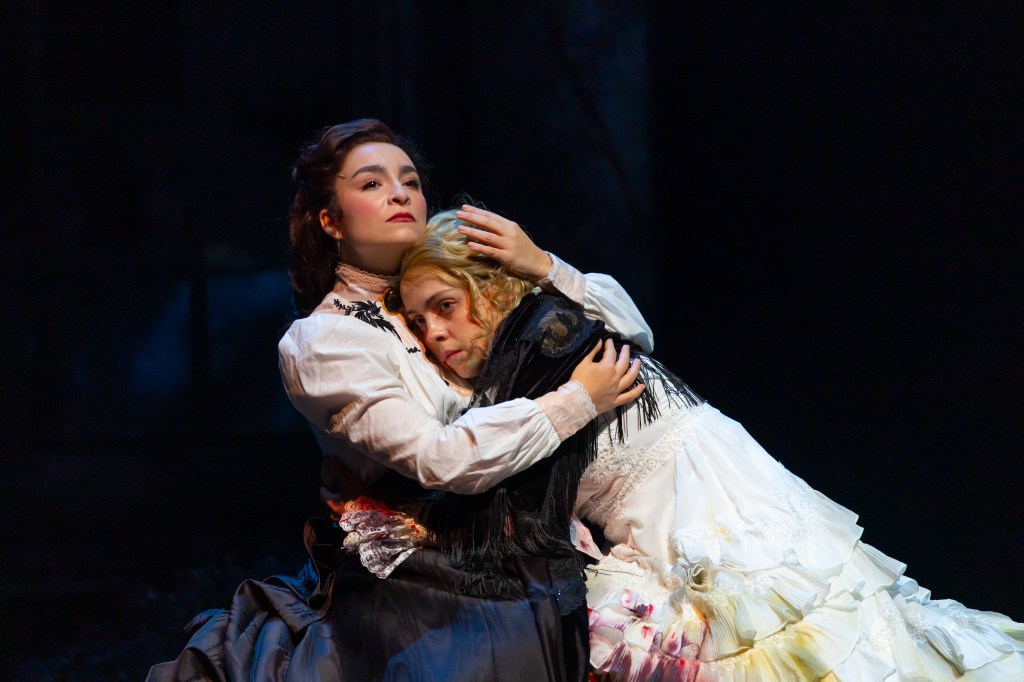
HARTFORD, CT — The vampire myth has evolved significantly since Bram Stoker wrote his seminal gothic masterpiece Dracula 129 years ago. For one reason or another, from Anne Rice’s erotic thrillers in The Vampire Chronicles to the sparkly vampires of Stephanie Meyer’s young adult Twilight series, the vampire has become less a symbol of evil, but an icon of dark eroticism. Morgan Lloyd Malcolm’s new stage adaptation, making its American premiere at Hartford Stage, running through Nov. 1, strips the erotic nature back, returning Dracula back to its sense of horror, and heightening the theme of sexual assault that the character of Dracula represents.
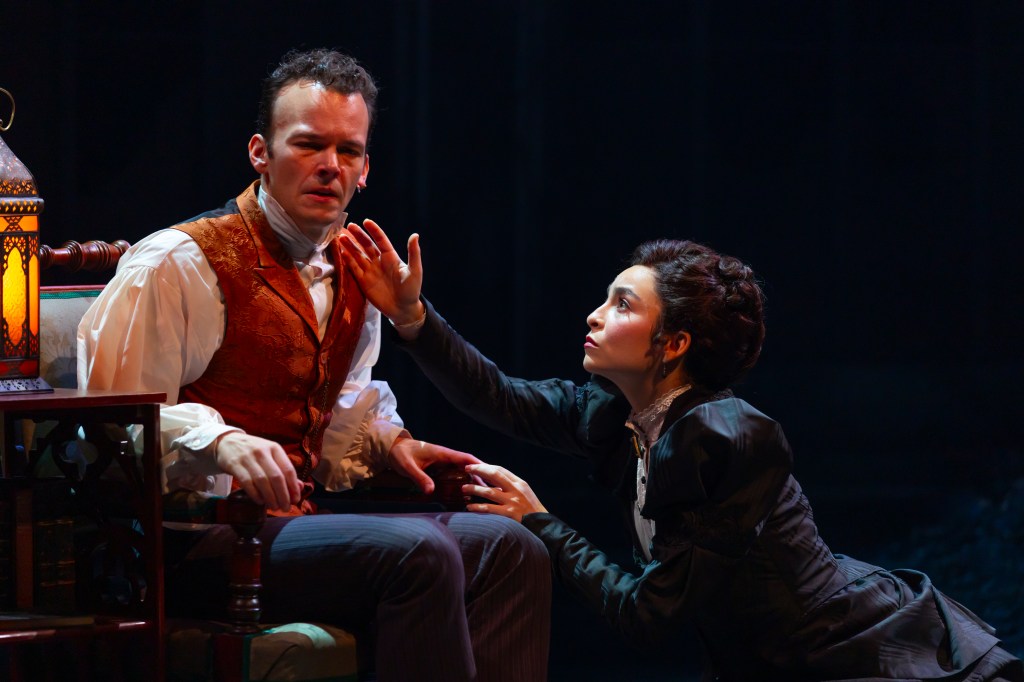
Directed by Jackson Gay, this adaptation of Dracula barely has the titular vampire visually represented in the play. There’s no one credited as the character, and when we do see him, he’s portrayed in shadow or disguised as an animal through some great costume designing by Fabian Fidel Aguilar. This removes any potential for making Dracula a visually attractive character for the audience. Another change is how the story it told. Traditionally, Dracula is told from the point of view of Jonathan Harker (Lucas Dixon). This time, the story is told past-tense from the perspective of his wife, Mina (Sara Gutierrez), who recounts the events to us, referencing Jonathan’s letters, but also giving the story her own developed point of view.
(Production photo courtesy of Hartford Stage. Credit: T. Charles Erickson)
Changing the perspective is refreshing and brings some genuine horror back to the Dracula story. Over the years, the vampire has evolved from a metaphor for rape into something sometimes disturbingly permissive. Morgan Lloyd Malcolm’s adaptation throws out those pretenses and reminds us that Dracula is an assailant. A violent, brutal, manipulative creature. In addition, her version of the play emphasizes the impact of an assailant on the female characters of the story, Mina and Lucy (Scout Backus), and how the two respectively respond to the trauma of Dracula’s assault. This perspective shift gives the play a powerful immediacy to the story.
There is some revision with how the story ends, which purists may rankle against, but when consuming the play as a feminist piece, where Mina reclaims her autonomy, the play’s ending — particularly the epilogue — holds an assertiveness that can be viewed as empowering, particularly for people who have been experienced abuse. There’s a theme of love being perverted into something evil that ties into the ending, which depending on how you interpret it, can undercut the message seemingly presented through the rest of the play, or can put a diabolically ironic twist to the end.
(Production photo courtesy of Hartford Stage. Credit: T. Charles Erickson)
As pleasing as the play is with its both restorative and revisionist interpretation, the play is overwhelmingly dependent on narration from Mina, which can make it a bit of a slog, as significant parts of the story is told, not shown. This is not a slight against Gutierrez’s performance, which I found to be passionate and authoritative. It has more to do with Morgan Lloyd Malcolm’s dependence of telling the story versus showing us the story. Whether this was a creative decision in the writing or in the original development of the piece at the Lyric Hammersmith Theatre in London, the minimizing of the cast doesn’t always payoff with its humor. For example, Lucy’s three suitors are reduced to two men and a gramophone. It plays to Mina’s opinion of the three men, reducing them to comical tropes, which is fine, but with how serious so much of the rest of the play lands, the humor feels like it belongs in a different play sometimes.
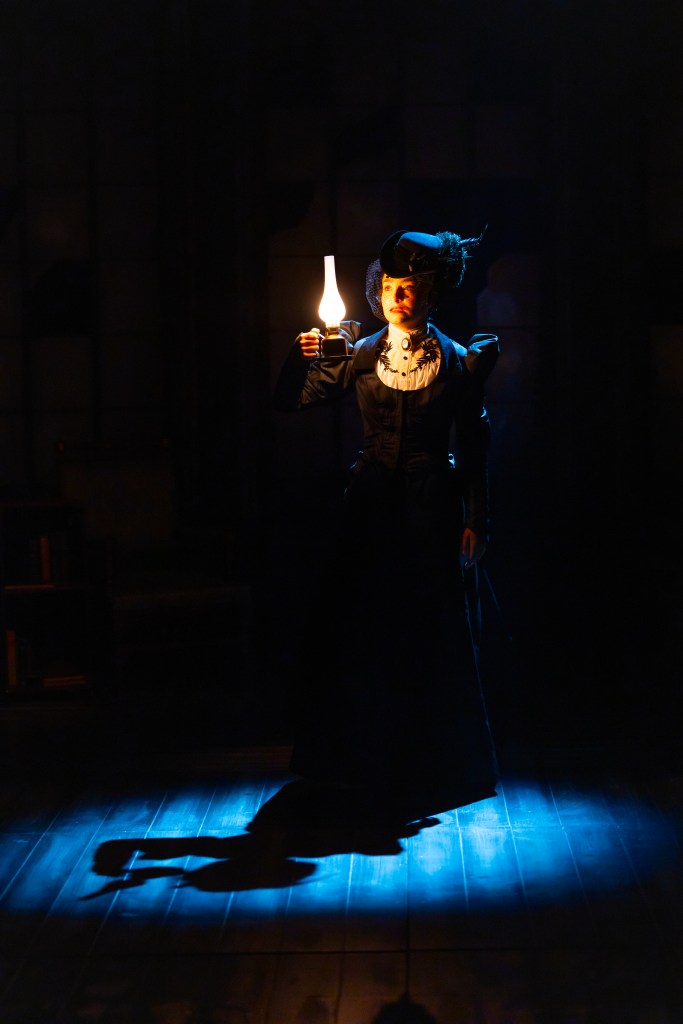
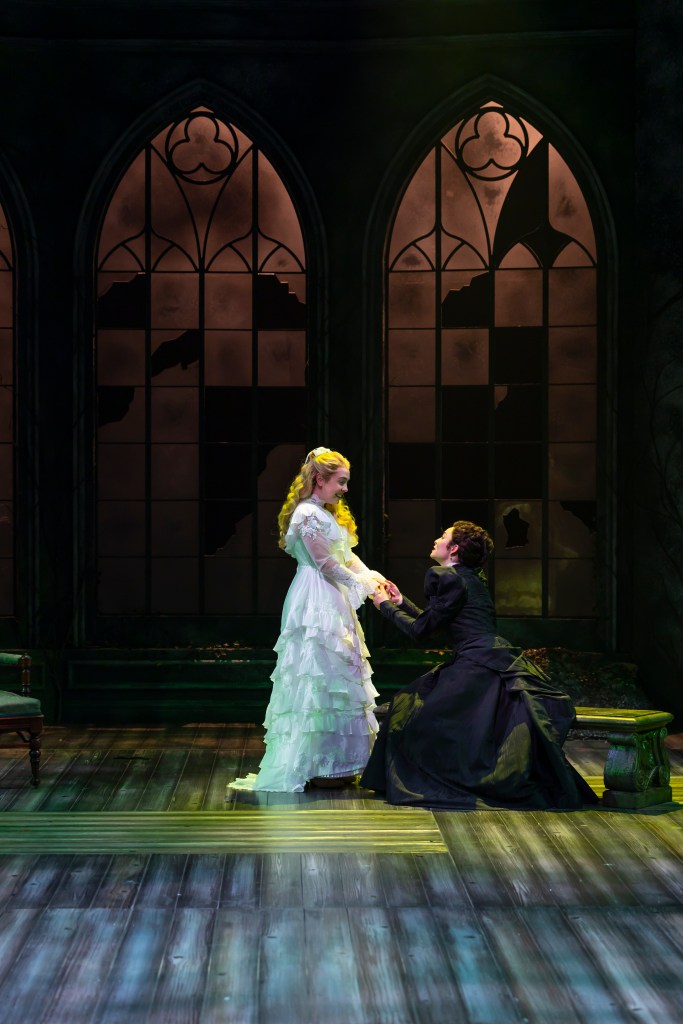
The design is fantastic. Riw Rakkulchon’s gothic design is rich in texture and composition. Paul Whitaker’s lighting and Caroline Eng’s sound add layers of color and character as shadows and images of creatures move about around the stage.
(Production photo courtesy of Hartford Stage. Credit: T. Charles Erickson)
The supporting ensemble backing Gutierrez’s commanding performance are all exceptional. Backus, in particular, gets several moments as Lucy to let herself give her entire being over to the role in a thrashing, passionate, convulsion of incomprehensible horror.
Morgan Lloyd Malcolm’s new interpretation of Dracula is refreshing if at times frustrating. I love the idea of bringing a fresh perspective to the story through Mina, but much of the story is dependent upon narration, and the humor sometimes feels out of place. Still, invigorating performances, led by Sara Gutierrez, and an immersive design, keep this Dracula’s empowering feminist message engaging and entertaining.
TICKETS: https://www.hartfordstage.org/
PRODUCTION
Written by Bram Stoker; Adapted by Morgan Lloyd Malcolm; Directed by Jackson Gay; Scenic Design: Riw Rakkulchon; Costume Design: Fabian Fidel Aguilar; Lighting Design: Paul Whitaker; Sound Design: Caroline Eng; Wig, Hair & Make-up Design: Tommy Kurzman; Fight Director: Rod Kinter; Movement Coordinator Shura Baryshnikov; Dialect & Voice Coach: Julie Foh; Casting: Alaine Alldaffer, CSA and Lisa Donadio; Production Stage Manager: Avery Trunko; Assistant Stage Manager: Theresa Stark; Director of Production: Bryan T. Holcombe; General Manager: Emily Van Scoy
CAST
Scout Backus as Lucy, Ensemble
Caitlin Elizabeth Clouthier as Ensemble
Lucas Dixon as Jonathan
Anney Giobbe as Ensemble
Sara Gutierrez as Mina
Pauli as Ensemble


Leave a Reply