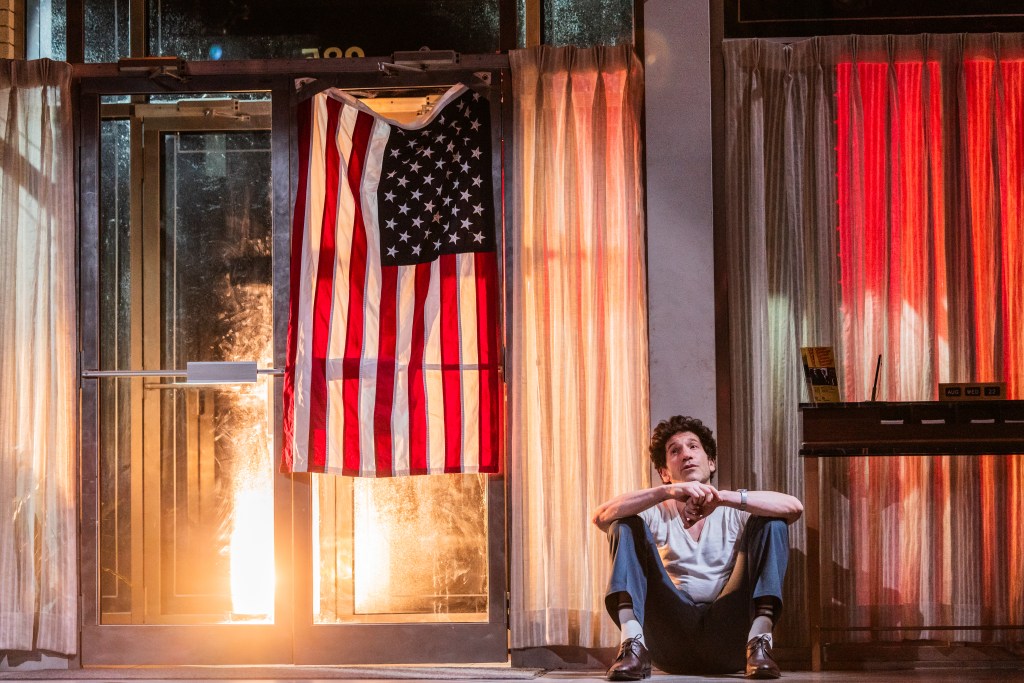
(Jon Bernthal (“Sonny”) Production photo by Matthew Murphy and Evan Zimmerman)
by Tim Leininger
NEW YORK — I’m not opposed to adaptations of quality films into stage adaptations. There have been a handful of good ones, Waitress, The Lion King, The Full Monty, Hairspray and The Producers are all stage adaptations that elevate the original version into something unique. It’s finding something new and special to make the adaptation worthwhile that seems paramount to make it worth seeing. With Stephen Adly Guirgis’ adaptation of the 1975 Sidney Lumet film Dog Day Afternoon, both of which are adapted from the P.F. Kluge and Thomas Moore article for Life Magazine “The Boys in the Bank,” it feels more like a paint by numbers adaptation with mostly solid performances and a dependence on dynamic scenic design to keep it afloat. The stage production, directed by Rupert Goold, is currently running on Broadway at the August Wilson Theatre at 245 W. 52nd St.
The film version of Dog Day Afternoon is a classic with Al Pacino and John Cazale as two bank robbers who get trapped in the bank through the worst case of Murphy’s Law, as the third member of the heist chickens out, the security guard has a coronary, and worst of all, there’s almost no money in the bank. When a witness notices that the bank is being held up, the police quickly come down on the bank, trapping our two antiheroes inside. The story reflects the growing fervor of antiestablishment attitudes that was growing at the time, as recent history of police brutality quickly causes the crowds that have amassed at the bank treat Sal and Sonny as heroes instead of villains. Therein lies the theme of the story, which is still relevent today, as Sal and Sonny become symbols of resistance against the establishment that has driven them to commit the crime in the first place. Issues of proper health and mental health care come to the fore as Sonny’s lover’s health motivates him.
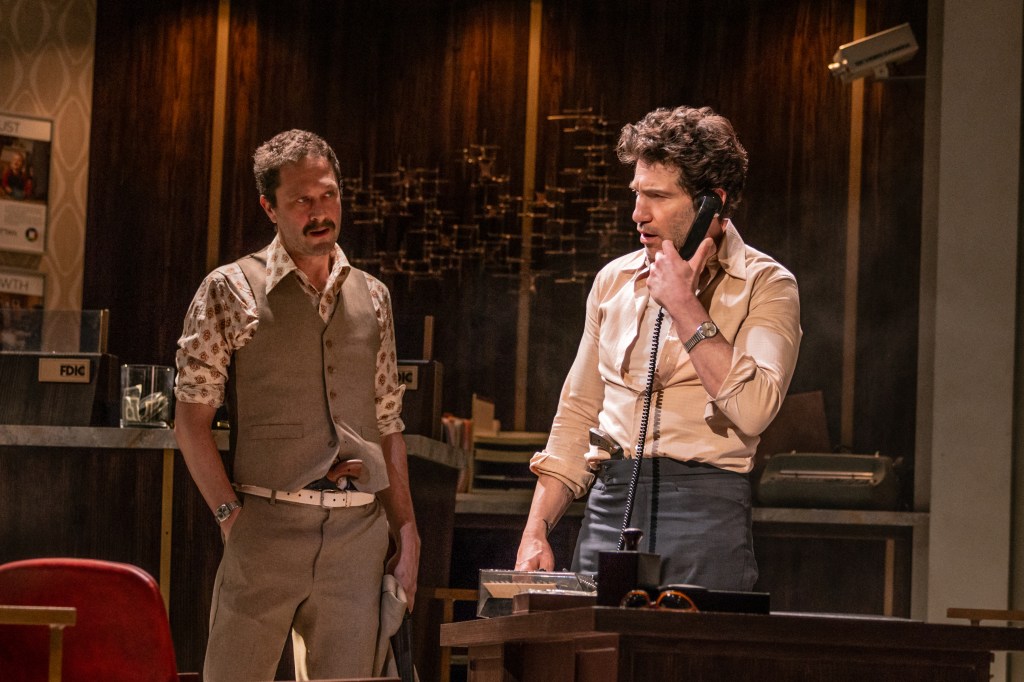
(L to R: Ebon Moss-Bachrach (“Sal”), Jon Bernthal (“Sonny”), production photo by Matthew Murphy and Evan Zimmerman)
The problem with the stage version, though, is that Aldy Guirgis overstates some of the issues, particularly at the end where Sonny is given this unnecessary monologue intended to spell out to the audience what they’ve just seen and why it’s important. An audience should be given more credit than to have the language of the play simplified and the moral of the story explained.
The plot is basically identical, with Jon Bernthal giving his best Pacino impression as the character Sonny, and Ebon Moss-Bachrach as the sidekick Sal. As much as Bernthal does a pretty solid impression of Pacino as Sonny, Moss-Bachrach goes the completely opposite direction with Sal. Cazale’s performance in the film is pretty neurotic and scared, while Moss-Bachrach turns the role, bringing a much more psychotic quality. Sal doesn’t have nearly as many lines as Sonny, and Moss-Bachrach makes him like a looming angel of death that tends to hover in the corner of the stage. There are a few moments where he starts to open up with some genuine softness, particularly with Paola Lázaro, who plays one of the workers at the bank, who attempts to empathize with him.
The real shining star of the play is Jessica Hecht as head teller Colleen, who plays foil to Sonny, pointing out at every opportunity to make him realize how futile his actions are. Hecht’s expression of care for her team as Colleen as well as her growing empathy for Sal and Sonny gives the play the needed emotional depth that the play requires to keep it from growing too cold.
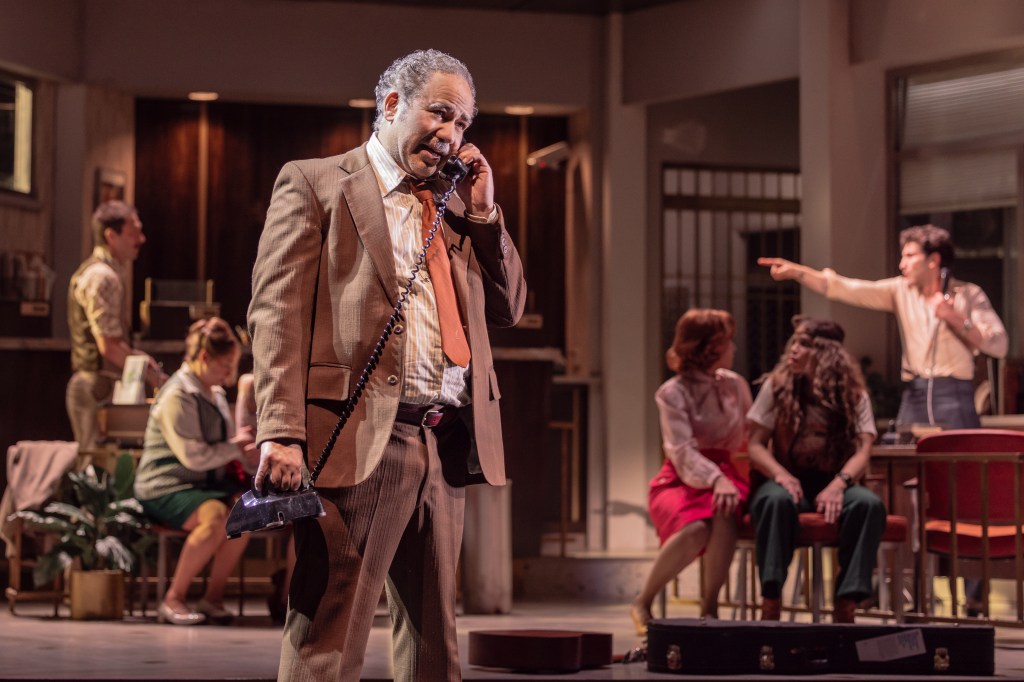
(John Ortiz (“Detective Fucco”), production photo by Matthew Murphy and Evan Zimmerman)
Visually, the scenic design by David Korins is impressive with its rotating set that has the bank exterior set up stage left before rotating the whole thing outward onto the stage, filling the whole stage with the bank interior. Smaller scenes set at a nearby deli with Detective Fucco (John Ortiz) who is investigating the robbery is done downstage with smaller set pieces that doesn’t feel tacked on or encroaching on the rest of the set. Brenda Abbandandolo’s early 1970s costume design feels dirty, sweaty, and worn, which looks fantastic.
As a stage adaptation, Dog Day Afternoon is serviceable. There’s a novelty to seeing it set on stage. But the story’s message of resistance and the oppression and betrayal of the government is watered down with clunky dialogue and an ending that feels force fed. Aside from a fantastic performance by Hecht, the rest of the cast is decent. There isn’t anything that feels new or earned in this adaptation. I’d recommend just loading up the film version.
TICKETS: https://www.dogdayafternoon.com
PRODUCTION
Written by Stephen Adly Guirgis; Based on the article “The Boys in the Bank” written by P.F. Kluge and Thomas Moore, published by Life magazine and the Warner Bros. Film “Dog Day Afternoon”; Directed by Rupert Goold; Scenic Design: David Korins; Costume Design: Brenda Abbandandolo; Lighting Design: Isabella Byrd; Sound Design: Cody Spencer; Hair & Wig Design: Leah J. Loukas; Makeup Design: Katie Gell; Casting Director: Bernard Telsey, CSA, Karyn Casl, CSA; Production Stage Manager: Barclay Stiff; Voice & Dialect: Kate Wilson; Associate Director: Rory McGregor; General Manager: WJP, Dylan Glen; Assoicate General Manager: Allison Kupfer; Company Manager: Chandler Jez; Production Manager: Juniper Street Productions; Advertising: AKA; Public Relations: Polk & Co.; Digital Marketing: Sine Digital; Executive Producer: Zachary Baer
CAST
Jon Bernthal as Sonny
Ebon Moss-Bachrach as Sal
John Ortiz as Detective Fucco
Jessica Hecht as Colleen
Spencer Garrett as Sheldon
Michael Kostroff as Butterman
Elizabeth Canavan as Roxxanna/Gloria
Esteban Andres Cruz as Leon
Danny Johnson as Mr. Eddy
Paola Lázaro as Guadalupe
Wilemina Olivia-Garcia as Lorna
Christopher Sears as Ray Ray
Michael Shayan as Young Nesbit
Jeff Still as Widower Dave
Andrea Syglowski as Alison
Ensemble: Brian D. Coats, Alex J. Gould, Dom Martello, Michael Puzzo, Carment Zilles


Leave a Reply