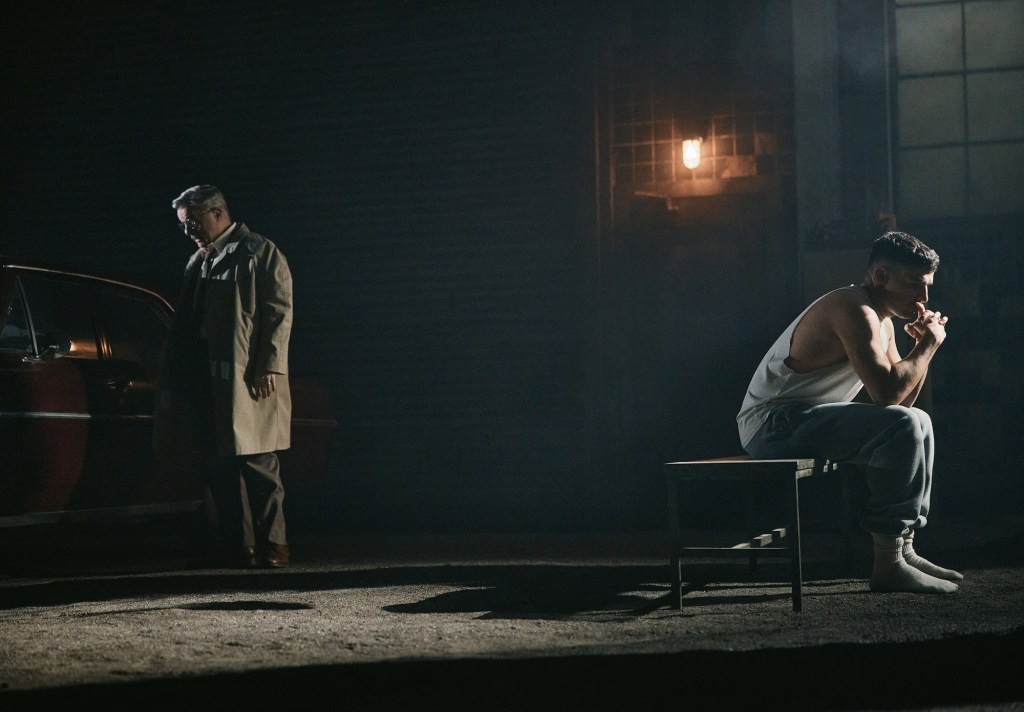
(Nathan Lane and Christopher Abbott. Photo by Emilio Madrid)
by Tim Leininger
NEW YORK — Theater is ever evolving, and I think most people understand that. Sometimes, a popular, oft revived play or musical must evolve in order to keep a degree of freshness about it. Some recent productions, like Cats: The Jellical Ball and Masquerade are excellent examples of giving a show a different aesthetic to give it a new freshness about it. Other times, an idea falls flat. Such is the case for Joe Mantello’s vision for Arthur Miller’s Death of a Salesman, currently running through Aug. 9 at the Winter Garden at 1634 Broadway.
An American classic Death of a Salesman is the tragic tale of traveling salesman Willy Loman (Nathan Lane) whose age is getting the best of him as he is forced to decide what to do with his life as he can no longer feasibly do the job he’s been doing his entire life, making just enough money to keep the house in some order of repair. His faithful wife Linda (Laurie Metcalf) does her best to keep everything afloat, while the two sons Biff (Christopher Abbott) and Happy (Ben Ahlers) look to make their own mark on the world, preferably without Willy’s interference.
Traditionally, the play is mostly set within the Loman home with a few scenes, like a motel room, an office, and a restaurant taking shape downstage of the house or far stage left or right. But ultimately, there’s a symbolism of the Loman home in the set design as this place of security, something to fight for, though it may be a bit run down here and there. That is gone as we are left with Willy Loman driving his Studebaker (at least, it’s supposed to be a Studebaker from the 1940s) downstage, which becomes the central focus of the play as it sits in what looks like a rundown dimly lit parking garage. Designed by Chloe Lamford, lit by Jack Knowles, the whole concept of this production strips the humanity away from it visually. Instead, we have this instrument that people, like me who have seen this play as many times as I have, recognize as something far more final sitting there at the top of the play. It ends up making the play start already in a horribly depressing spot instead of building on Willy’s hopes for his legacy in his two sons, Biff and Happy. It gives the play nowhere to visually go as it already sits in about as depressing an environment as possible from the beginning.
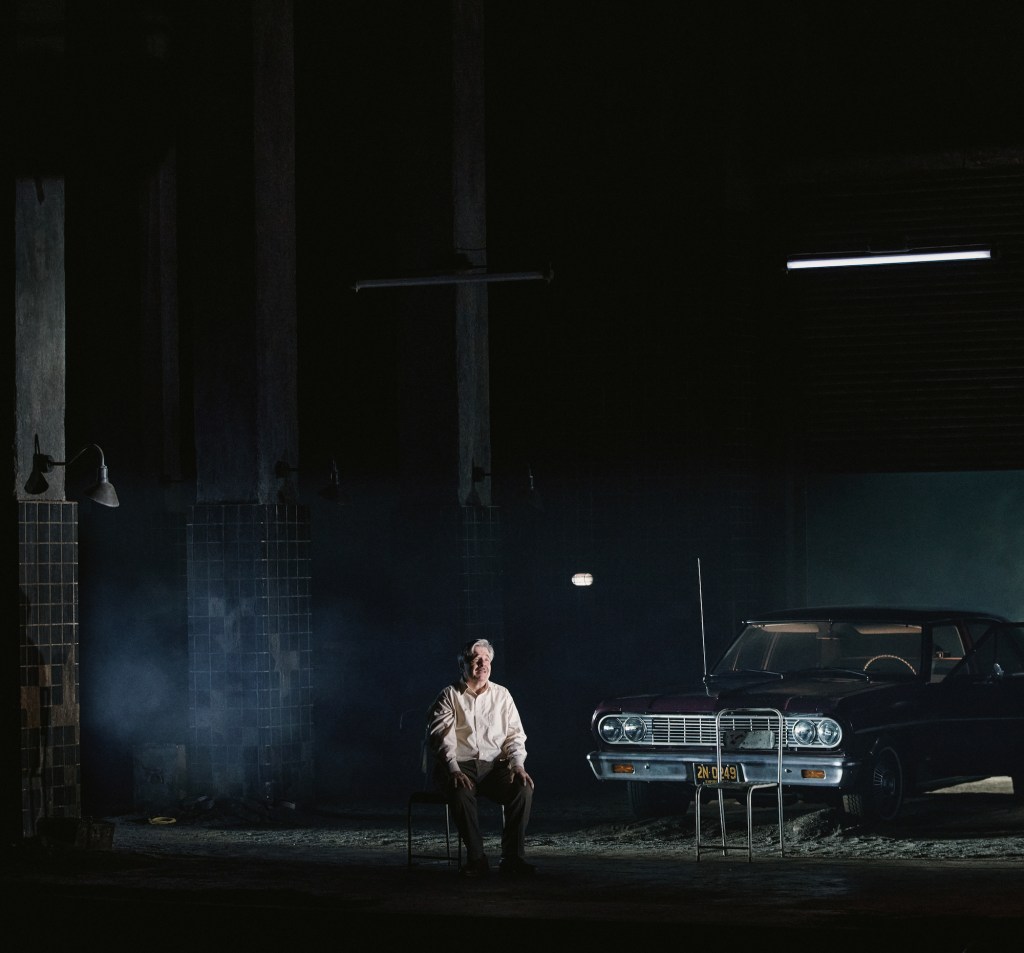
(Nathan Lane. Photo by Emilio Madrid)
Thankfully the cast keeps the play from being a completely devoid of life. Lane is a solid Willy Loman. He doesn’t have the gravitas of previous Willy’s I’ve seen like Brian Dennehy or Wendell Pierce, but he has an earnestness that works for a small man in a large world who just wants his piece of the American dream. Laurie Metcalf is amazing as Linda, defending Willy with a ferocious fervor that demands attention, not for herself, but for him; most importantly, she directs this at their two sons, who don’t appreciate his lifelong effort to advance in the world. Granted, this pursuit is tainted by the fact that Willy has had a long-time affair with a woman (Tasha Lawrence) in Boston that was discovered by Biff as a teen (Joaquin Consuelos), an event that completely altered Biff’s perception on not only his father, but the world as his immediate actions following the discovery changes his trajectory. Abbott’s performance the day I saw the show was uneven in Act I, but by the time he and Willy have their final confrontation he was firing on all cylinders, giving an impassioned performance full of fire and fury.
There are some great moments in this Death of a Salesman. Mantello knew what he wanted from the cast, and he got strong performances from them. But the design has it feeling weighted down, sinking the narrative into the proverbial cellar before the story asks for it to get there. There are also some other odd choices by Mantello. Caroline Shaw’s score, written for the production, feels invasive and distracting. Also, maybe Mantello was looking to make the play feel more timeless with Rudy Mance’s costuming, but having Howard Wagner (John Drila), Willy’s boss, wearing closer to modern dress and carrying what looks like Starbucks cup while they talk about the latest analog dictation machine feels anachronistic and removed me from the reality of the text.
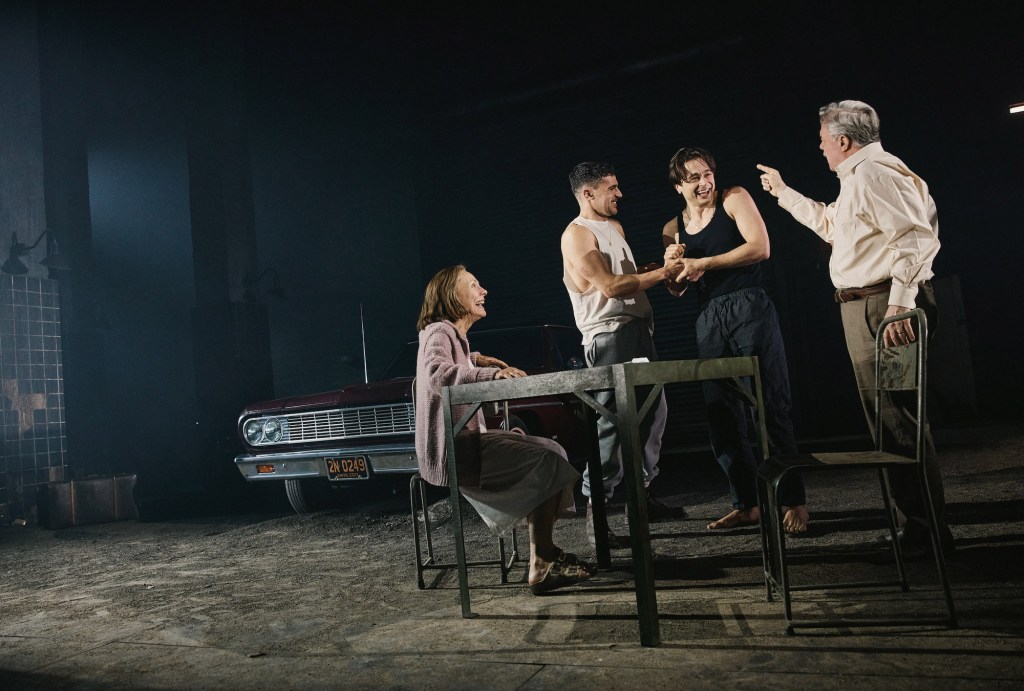
(Laurie Metcalf, Christopher Abbott, Ben Ahlers and Nathan Lane. Photo by Emilio Madrid)
Death of a Salesman is one of the greatest plays ever written, with its tragic tale of a man, flawed as he is, desperately hold onto that one little slice of the American dream that he identifies as his while the world around him decides whether to move on with or without him. It’s a journey that should start the audience (yes, even us who’ve seen it a dozen times) from a place of hope. This isn’t that. Mantello starts us in the cellar, and all I ask for is a bit of sunlight to give Willy — and in extension the audience — some hope.
TICKETS: https://salesmanbroadway.com/
PRODUCTION
Written by Arthur Miller; Directed by Joe Mantello; Music by Caroline Shaw; Scenic Design: Chloe Lamford; Costume Design: Rudy Mance; Lighting Design: Jack Knowles; Sound Design: Mikaal Sulaiman; Hair & Wig Design: Robert Pickens; Casting: Taylor Williams, CSA; Vocal Coach: Kate Wilson; Movement Direction: Sasha Milavic Davies; Production Stage Manager: Charles Means; Associate Director: Lily Dyble; Technical Supervision: Sightline Productions: Marketing Director: Anna Pitera DeVito; Public Relations: DKC/O&M; Press Consultant: Lee Abrahamian; Advertising & Marketing: Arthouse; Company manager: Mike McLinden; General Manager: RCI Theatricals, Joe Christopher; Danielle Karliner Naish
CAST (in order of appearance)
Nathan Lane as Willy Loman
Laurie Metcalf as Linda
Christopher Abbott as Biff
Ben Ahlers as Happy
Joaquin Consuelos as Young Biff
Jake Termine as Young Happy
Karl Green as Young Bernard
Tasha Lawrence as The Woman
K. Todd Freeman as Charley
Jonathan Cake as Uncle Ben
Michael Benjamin Washington as Bernard
Jake Silbermann as Stanley
Katherine Romans as Miss Forsythe
Mary Neely as Letta


Leave a Reply